Ten genuine shifts.
And still at the desk.
Sysadmin, web developer, and product builder since 1999. PHP and Linux from the start, cloud when it arrived, LLMs once they changed everything. I build things that run: a screenshot API, infrastructure tools, and document hosting services.
Available for Linux infrastructure that you'd rather not think about, web work that has to last, and technical advisory when someone in the room needs to have seen this before.
Atari 520STe
First machine.
Already more interested in how it worked than what it did.
Every constraint was visible: processor speed, RAM limits, the bus.
Starting there meant approaching computing as machine, not magic.
Learning without abstraction layers changes how you reason about
systems later.
The habit of looking underneath stuck.
Linux
Watched Apache, then MySQL, then the entire LAMP stack displace commercial Unix on production servers. Pre-mainstream, all of it.
The idea that free software would run the internet
was not obvious at the time. Corporations were still paying
per-seat for Solaris licences.
The idea that a Finnish student's kernel would underpin global infrastructure sounded absurd.
It wasn't.
Open Doors
Telnet was everywhere. Passwords crossed the wire in plaintext, readable by anyone listening. SunOS boxes shipped with default accounts no one ever changed. Major infrastructures less locked down than their actual importance required.
Wardialing toll-free numbers to find modems. Bouncing through open proxies,
landing on a Japanese mainframe by accident.
Curiosity outran the rules because the rules barely existed yet.
The doors were open.
That didn't make it right.
The Open Web
PHP, sysadmin work, first professional projects at ISDnet: ISP-scale web, mail, and usenet clusters. HTTP + HTML + PHP turned publishing into programming. Running infrastructure while building on top of it.
The web was genuinely open: no algorithmic gatekeepers, no app store approvals,
no platform permissions.
An idea and a server were enough.
That simplicity felt natural, structural.
The Rollover
No end of the world, despite the predictions. Months of audit work, patching, and late-night paranoia for a midnight that passed quietly. The preparation was probably the reason. Nobody remembers the crises that didn't happen.
BGP in the Kitchen
ADSL at home. No more tying up the phone line, no more scheduled download windows, no more listening to the modem negotiate its handshake at 9 pm. The web became always-on and the psychology shifted with it.
Personally: dual SDSL uplinks, own AS number, BGP peering and IXs access,
full routing table in a 5 m² kitchen.
Not your typical home connection.
The Crash
Running high-traffic hosting infrastructure while clients quietly disappeared. Managing a small team, maintaining clusters for businesses that no longer existed. The servers kept running. The invoices stopped coming.
The hype died; the web didn't.
The 2000s were the hangover.
They were also the decade that built what lasted.
PageRank changed how the web works: not just search, but distribution. The web stopped being navigated by URLs and started being navigated by one company's algorithm. For a long time, that felt like a fair trade.
Until the algorithm started optimising for Google's revenue, not your relevance.
One update can now erase years of traffic overnight. Later, Facebook added attention
to Google's distribution.
Every web property became a tenant. Nobody signed the lease.
Cloud
The year before, I'd been running 200 Linux servers at EdenCast: peaks above 10 Gbit/s, BGP routing with Quagga then Cisco Catalyst 6500s. The kind of infrastructure work AWS was about to commoditise.
For sysadmins, this was existential. The entire discipline of racking servers, capacity planning, datacenter ops collapsed into a billing dashboard.
A one-person shop could run global infrastructure. The low-level knowledge didn't become useless; it became leverage. Knowing what the abstraction was hiding turned out to matter.
The Smartphone
iPhone.
The web had been designed for mice.
Responsive design, touch UX, the mobile-first decade.
Layouts that had worked for a decade broke overnight, hover states
vanished, and every site had to be rebuilt for a finger instead of
a cursor.
The irony: Steve Jobs spent his career building for cursors,
then shipped the thing that made all of it wrong.
Social Media
The platforms had been social since 2004. In 2016, it became obvious they were something else. Feeds replaced timelines. Algorithms replaced editors. Engagement metrics increasingly rewarded outrage. The Brexit vote. The US election. Attention as infrastructure, weaponised at scale.
Friendships flattened into follows, conversation into content.
Interaction went up, actual connection went down.
The loneliness came free with the feed. The name came later.
GDPR
The EU decided the internet needed rules. Overnight, every web property touching a European user had to think about consent, data residency, right to erasure.
For operators of French web properties: real paperwork, real liability, real compliance costs. The open web acquired a bureaucracy. Some of it was overdue. None of it was cheap.
Remote
Two weeks to flatten the curve. The entire knowledge economy moved home overnight. Zoom became a verb. Offices emptied. Everyone discovered what remote work meant. The infrastructure held.
It had been the default here for years. The world finally caught up. The isolation everyone called a crisis was just Tuesday.
LLMs
ChatGPT arrived in November 2022. The world kept moving. Then DALL-E: you typed a description, a face appeared. A face that had never existed, assembled from a century of absorbed visual culture.



The tools were fascinating, mind-bending.
But the shock came later.
Đổi Mới
Đổi Mới: Vietnam's 1986 economic reform. The system was rebuilt while running.
After the images, LLMs moved from generating
conversations and pixels to generating code.
Years of product work can now compress into weeks.
That's a different category.
Not painless. Not optional. Thirty years of context, now put to work.
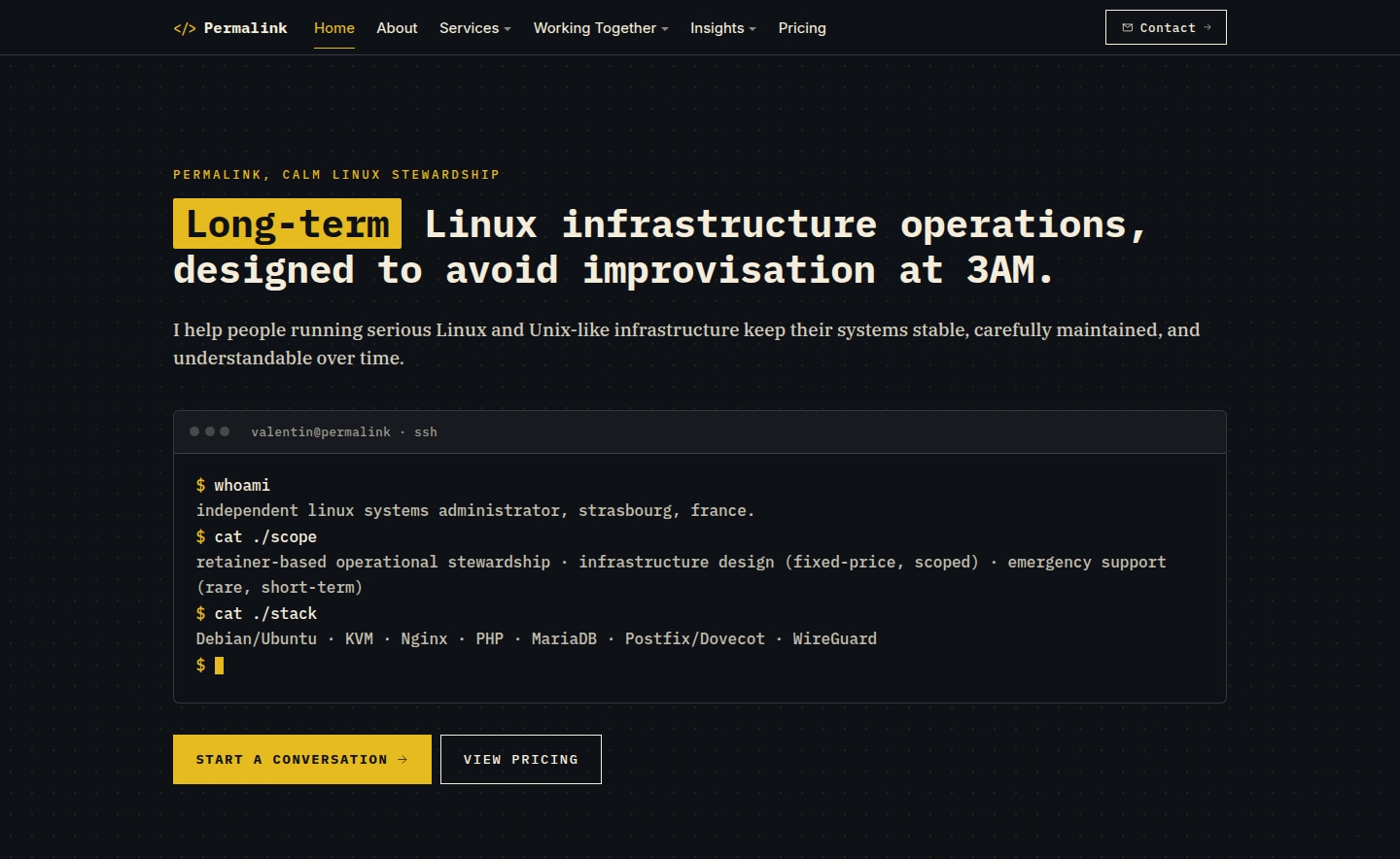
Ticket queues, team rotations, nobody who truly owns the outcome. The standard model for Linux & Unix infrastructure management.
Permalink is the other model. One operator, retainer-based, long-term, pricing
per infrastructure, not per server. The same person who set up the systems
maintains them carefully, and documents them over time.
Lock-in is avoided by design: access stays client-owned.
Retainer from EUR 900/month, after an audit phase. Covers monitoring, backup operations, DNS, incident response, and change management. Fixed-price infrastructure design available as a standalone engagement.
< Infrastructure that doesn't wake you at 3AM. >
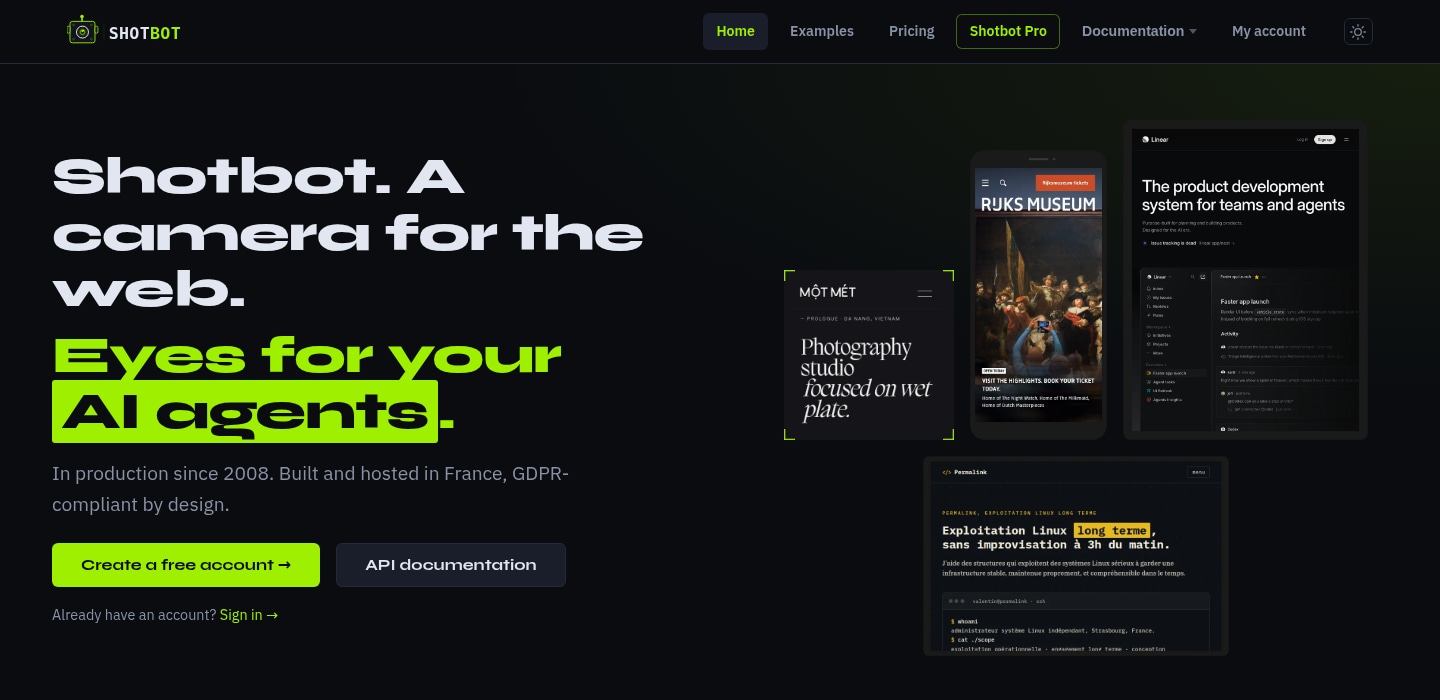
AI can now build a website from scratch.
But it can't look at it.
The tools built for AI agents are mostly about doing: clicking, navigating, filling forms. Shotbot is about seeing. Send a URL, get a screenshot.
Originally built in 2008 to generate ascreen.jpg for web directories. 120 by 90 pixels. One file.
Everything else is new: lossless PNG, WebP, AVIF, PDF. Free tier. Pro for higher
concurrency, custom viewports, full-page, element-level clipping, ad blocking.
CLI in PHP, Python, Node. MCP server for Claude Code, Cursor, Windsurf.
Eyes, not hands.
By accident, mostly.
That's it? That's it.
Open Source
Clients for the Shotbot API: a CLI and an MCP server for AI agents. MIT-licensed, published and maintained on npm and PyPI.
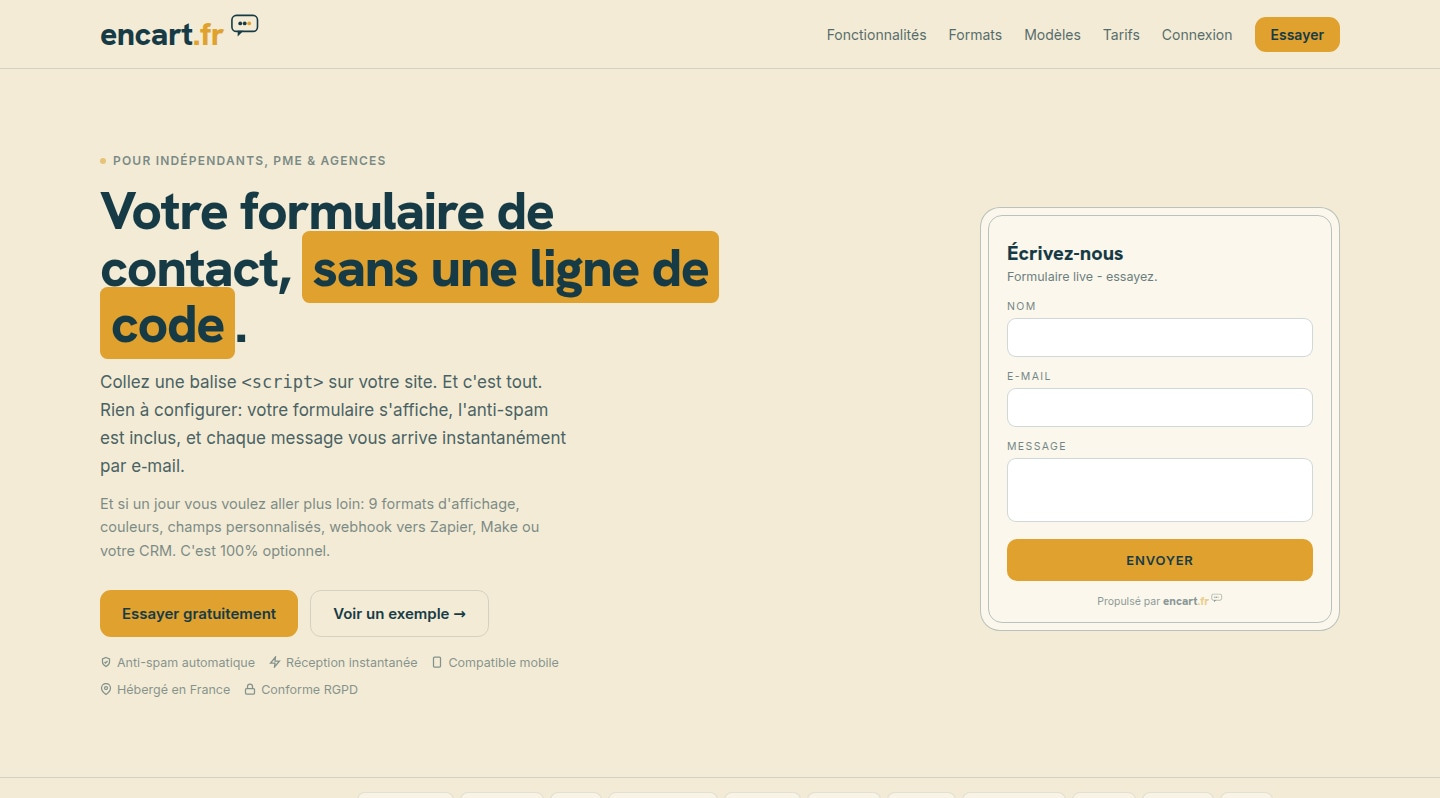
Every site needs a contact form. The form is the easy part. Keeping the bots out is the part nobody enjoys: a quiet arms race you maintain forever.
Encart is that arms race as a product. One <script> tag, pasted anywhere:
WordPress, Webflow, Shopify, plain HTML. The form renders, the spam is filtered,
and every real message reaches your inbox in real time.
No server, no database, nothing to keep alive.
The defense runs server-side and stays invisible: honeypot, rate-limiting, invisible proof-of-work, timing, disposable-domain blocking. No captcha, nothing for a visitor to solve. Hosted in France, GDPR-compliant by design.
Free to start, no credit card. Pro at EUR 9/month.
< Rien à faire. Ça marche. >
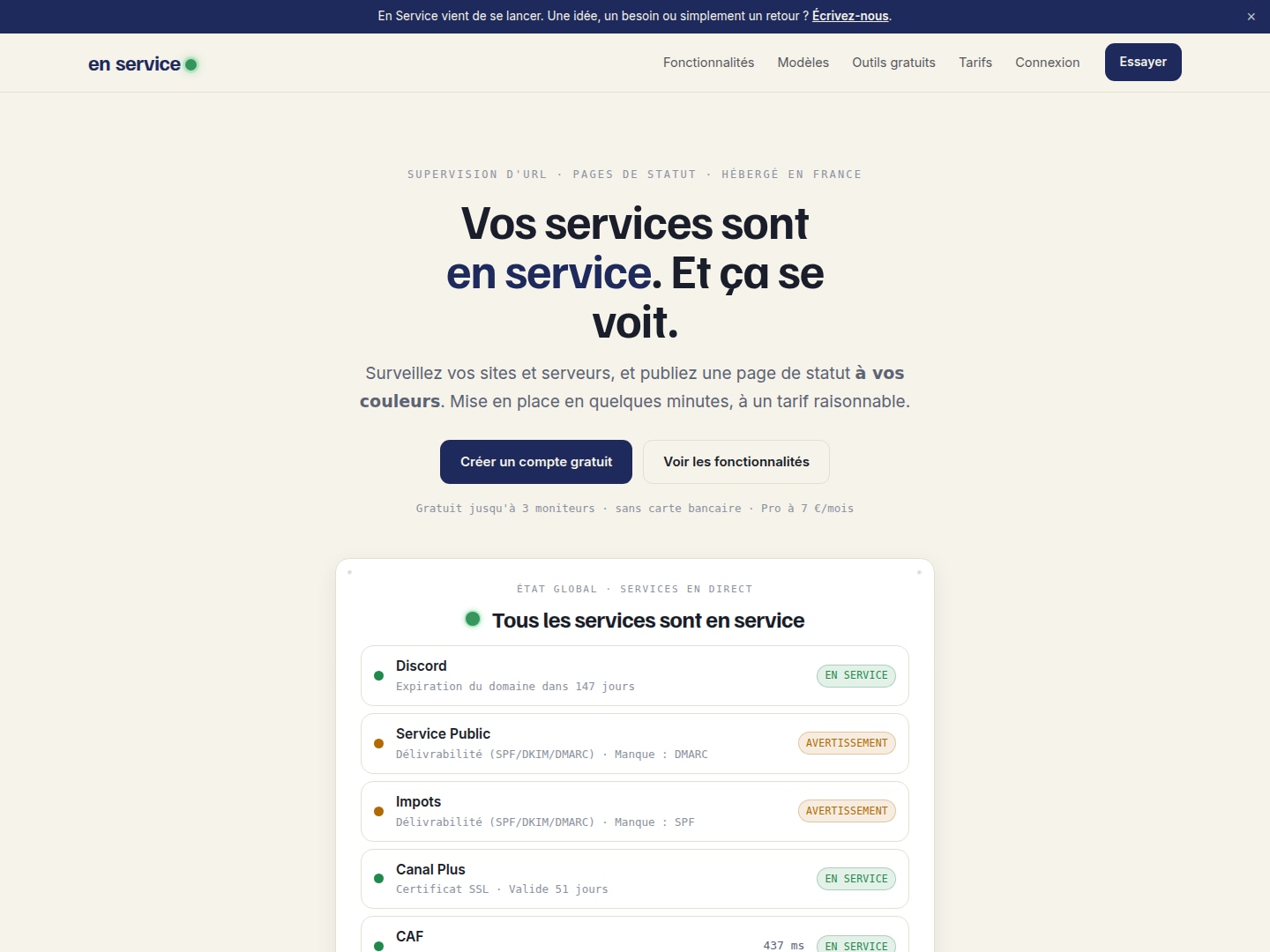
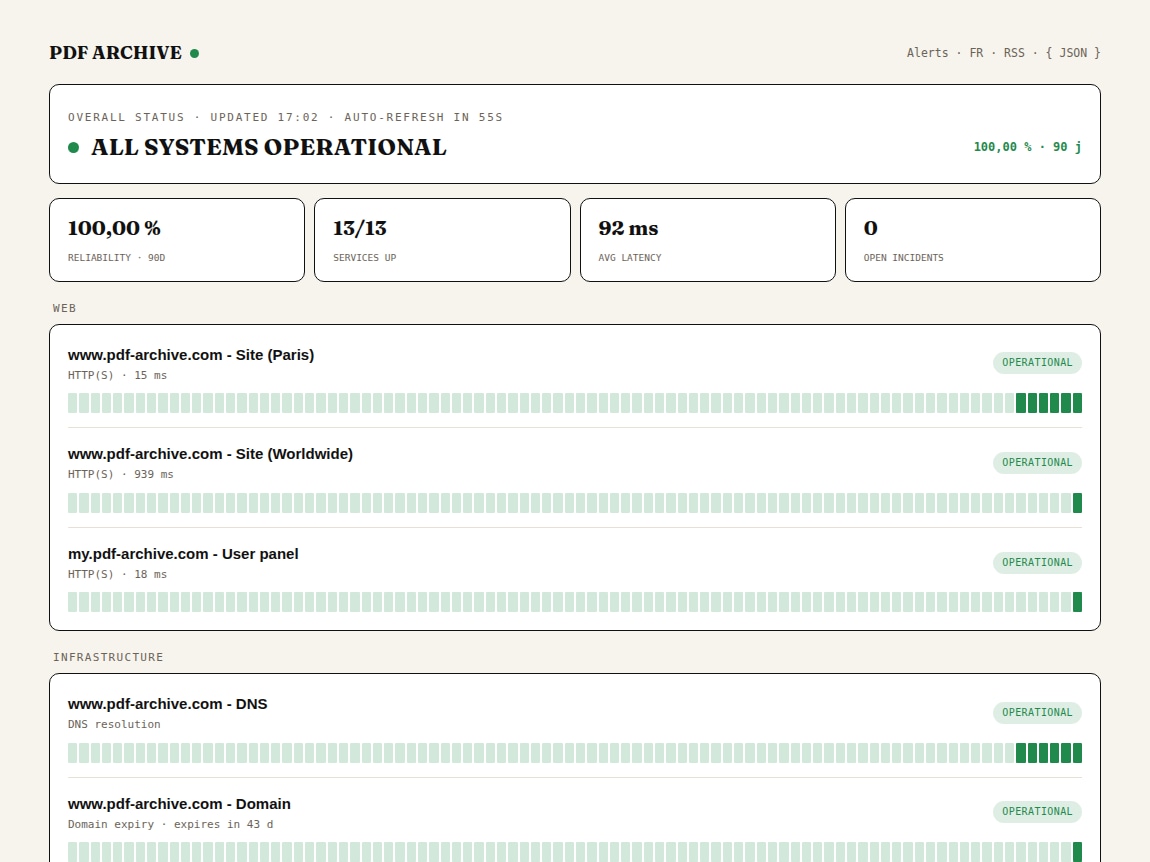
A service goes down. The only question is whether you hear it from your own monitoring or from an annoyed customer. Most teams find out from the customer, hours too late.
En Service watches your sites, APIs, and servers from probes in Paris, Strasbourg, Montréal, Singapore, and Sydney: HTTP, ping, TCP, DNS, and certificate expiry, plus disk, memory, and service health from a small open-source probe you run on the server itself. When something breaks, the alert reaches you by email, Slack, Telegram, Discord, webhook, or SMS, before the complaints do.
Then it publishes the part your users see: a status page in your own colours, on your own domain, in French or English, with incident history. Hosted in France, GDPR-compliant, your data staying in the EU. A French alternative to UptimeRobot and BetterStack, built on the same lightweight PHP and MariaDB as the rest of the shop.
Free for up to three monitors, no credit card. Pro at EUR 7/month.
< En service. Et tout le monde le voit. >
Open Source
The server probe that reports your server's disk, memory, CPU, and service health back to En Service. One small file, MIT-licensed, in PHP, Python, or POSIX shell. No daemon and no registry: download it, change the credentials in the header, and that's it.
Let's talk.
Tell me what you're working on. I read every message and reply within a few days.